Antemure · Autonomous Security Remediation Platform

Detection is solved.
Remediation isn't.

Every tool you own — EDR, MDR, XDR, SIEM, SOAR — stops at the alert. Antemure is the action layer that closes it: an autonomous agent that investigates the threat, runs the real fix, and verifies it's gone — in seconds, with no analyst in the loop.

Detect Reason Remediate Verify Learn
Every tool stops one step short

Your stack detects the attack.
Then it waits for a human.

EDR tells you a box is compromised. An ASRP fixes it. Here's exactly where each category stops — and where Antemure begins.

SIEMAggregates logs, runs correlation rules→ Raises an alert
EDRDetects malicious behavior on endpoints, can isolate→ "This host is compromised"
MDRHumans watch your tools 24/7, triage, notify→ "We told you + here's the runbook"
XDRCorrelates endpoint + identity + cloud + email→ One correlated incident (still an alert)
SOARRuns the automation playbook you pre-wrote→ Executes the script you already built
Antemure · ASRPInvestigates + remediates + verifies, autonomously→ Threat neutralized — the loop is closed

Antemure is not another detector. It's the layer that acts on everything the others surface — on the endpoint itself, not just in the console.

The three words vendors blur together

Detection ≠ Response ≠ Remediation.

Detection

"Something bad is happening."

EDR, XDR and SIEM live here. The output is an alert and a severity. Someone still has to act.

Response

"Contain the blast radius."

Isolate the host, disable an account. Most "auto-response" is isolate + notify — and the threat is still on the box.

Remediation

"The threat is gone, verified."

Kill the process, remove persistence, quarantine the payload, confirm clean. This is the work Antemure automates.

Everyone sells "detection and response." Almost no one delivers autonomous remediation. That gap is the entire reason Antemure exists.

How it works

One autonomous loop.
Detect → Reason → Remediate → Verify → Learn.

1 · Detect

Real-time

Endpoint syscalls, files and config across 13 collectors, plus 29 SIEM / identity / cloud integrations. Notify-driven, not polling.

2 · Reason

Multi-agent

LLM investigation fans out across five lenses and sub-agents, ATT&CK-mapped — redacted before anything leaves the box.

3 · Remediate

The real fix

An agent composes and runs the actual fix for this threat — kill, quarantine, de-persist, isolate — not a canned playbook.

4 · Verify

Proven clean

Re-checks the host and only closes when the threat is provably gone. Auto-rollback if a step regresses.

5 · Learn

Fleet-wide

Every incident + proven fix enters a fleet knowledge graph — the next agent reuses what already worked.

Guardrails at every step: it never touches the operator's access, never kills its own agent, enforces a forbidden-command list, and honors spend caps.

What Antemure does

One platform. Every part of the response.

The capabilities you'd otherwise stitch together from an EDR, an MDR, a SIEM and a SOAR — unified, and made autonomous.

Autonomous remediation

It runs the real fix

Kill the process, quarantine the payload, remove persistence, revoke tokens, control-plane-preserving host isolation — then verify clean. Real remediation on the endpoint, not just an alert or an API call.

Multi-agent investigations

Five lenses, one verdict

An LLM investigation fans out across five lenses and sub-agents — cause, network, blast radius, attack pattern, drift — each ATT&CK-mapped, synthesized into a risk score, root cause and the exact actions to take.

Ransomware protection

Stop the encryptor mid-run

Canary tripwires + a mass-encryption burst detector (T1486), shadow-copy/recovery deletion (T1490) and backup/AV service-stop precursors (T1489) → kill the encryptor, isolate the host, quarantine — before it finishes.

Shipping soon
Agentic SOAR

Playbooks that actually remediate

A native visual playbook builder with durable execution (Temporal) — playbooks trigger straight from real endpoint incidents, run without a human when authorized, and execute the actual fix under the same agent and guardrails. Deterministic where you want control, autonomous for the long tail.

Identity response

Act across the IdP

Password spray, credential stuffing, MFA fatigue and impossible-travel sessions → suspend the user, revoke sessions and block the source across Okta, Microsoft Entra, Duo and OneLogin; disable abused AWS access keys — guarded so it never locks out a break-glass account.

Fleet knowledge graph

One machine's fix protects all

When one node opens an incident, its indicators and the proven remediation propagate across the whole fleet — the same attack is caught and closed everywhere before it spreads. Cross-fleet immunity that compounds with every incident.

Honest coverage — attack matrix

Against 20 common attack types.
No hand-waving.

Antemure is the last, active layer — the one that assumes something got through and acts on it. Our promise isn't "we block every vector." It's "when an attack lands and executes, we detect and neutralize it autonomously."

7 Defends

Detects and autonomously remediates — the classes that execute on a host or abuse an identity.
MalwareRansomwareTrojan horsesPassword attacksBrute forceSession hijackingInsider threats

8 Partial

Doesn't sit on the email/web path, but reliably catches the endpoint or identity consequence — where the damage happens.
PhishingWhale-phishingSpear-phishingDrive-bySQL injectionURL / path traversalWeb / CSRFXSS

5 Complementary

Network- and crypto-layer attacks a firewall, TLS or DNSSEC defends. Antemure sits behind them and neutralizes whatever runs.
DoS / DDoSMITMDNS spoofingEavesdroppingBirthday (hash-collision)

Defense-in-depth: Antemure is the endpoint & response layer and acts through identity via integrations — it complements your firewall, WAF, email gateway, DNS and IdP rather than replacing them. Full Attack Coverage Matrix available for your vendor due-diligence review.
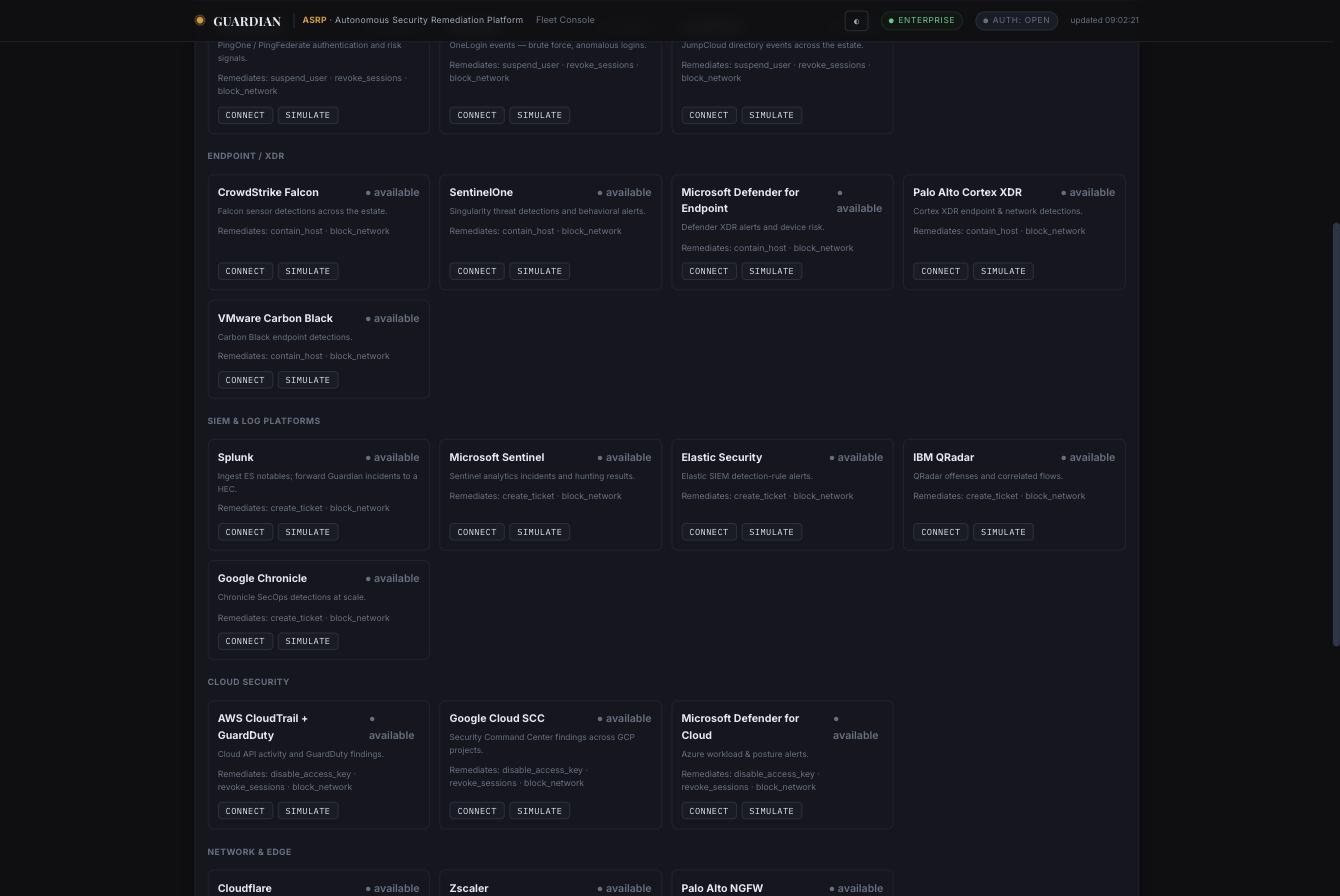
Antemure connected sources: CrowdStrike, SentinelOne, Microsoft Defender, Okta, Microsoft Entra and more
Sits behind the controls in front of it — integrates with EDR/XDR, identity & SIEM (29 connectors)
Aligned to regulatory compliance

Compliance-ready for
regulated industries.

Antemure maps, control-for-control, to the frameworks that govern regulated sectors — from the MAS Technology Risk Management Guidelines and Notice on Cyber Hygiene in financial services to the safeguards required across healthcare and beyond. It's a security control and an evidence source: it strengthens your compliance posture and control self-assessment, and the filing always stays yours.

Incident management

Detect → remediate → verify

Machine-speed response, approval-gated by default. Fast detection + SIEM export feed your regulatory breach-notification window (e.g. MAS's 1-hour rule); a per-incident reasoning transcript + command log + ATT&CK mapping give you regulator-ready root-cause material ahead of the required deadline.

Access control & PAM

Least privilege, fully audited

RBAC (Viewer / Operator / Admin) with SSO/AD and MFA at the IdP. Autonomy is approval-gated and scoped, every privileged action attributed in an append-only audit — and the agent is hard-blocked from operator SSH, keys and auth files.

Resilience & availability

Not a single point of failure

Self-healing agent + watchdog and multi-hub failover, with a DR/BCP plan provided. Containment is non-destructive — it preserves loopback, SSH and the control plane — so Antemure is never a SPOF for the estate it protects.

Cryptography & data

Your data stays put

TLS (rustls) in transit with its own root store; an AES-256-GCM write-only credential vault. On-prem / air-gap / BYO model with no mandatory data egress — secrets and PII are redacted before anything leaves the box.

Third-party / outsourcing

Ready for vendor due-diligence

Security whitepaper, MAS TRM & Cyber Hygiene mapping, attack-coverage matrix, vendor security questionnaire and a Right-to-Audit clause provided. Open formats and standard SIEM export mean no lock-in of your data.

Operations & monitoring

Continuous, with evidence

Real-time detection, a live metrics scorecard (MTTD / MTTR, coverage, autonomous-remediation rate), a fleet knowledge graph, and SIEM export over CEF/syslog or Splunk HEC for your SOC and management reporting.

The same control set maps across regulatory frameworks. Full evaluation pack — Security Whitepaper, MAS TRM & Cyber Hygiene mapping, Attack Coverage Matrix, Vendor Security Questionnaire, Right-to-Audit clause and DR/BCP plan — available under NDA.

The #1 question: "Isn't autonomy risky?"

Autonomy a CISO can actually approve.

The real risk isn't acting too fast — it's dwell time. The average breach goes undetected for roughly ten days. Speed is safety, and every action is bounded.

  • Off by default: ships approval-gated; full autonomy is an explicit, per-scope opt-in — with an observe-only "watch" mode for the first POC weeks.
  • Hard guardrails: it can never remove operator access, kill its own daemon, sever the network wholesale or reboot the host — enforced by a forbidden-command list in code.
  • Verified & reversible: an incident only closes when the threat is provably gone, with auto-rollback if a step regresses.
  • Total transparency: every command, its reasoning and its result live in an append-only, per-incident audit trail. It never fails open.
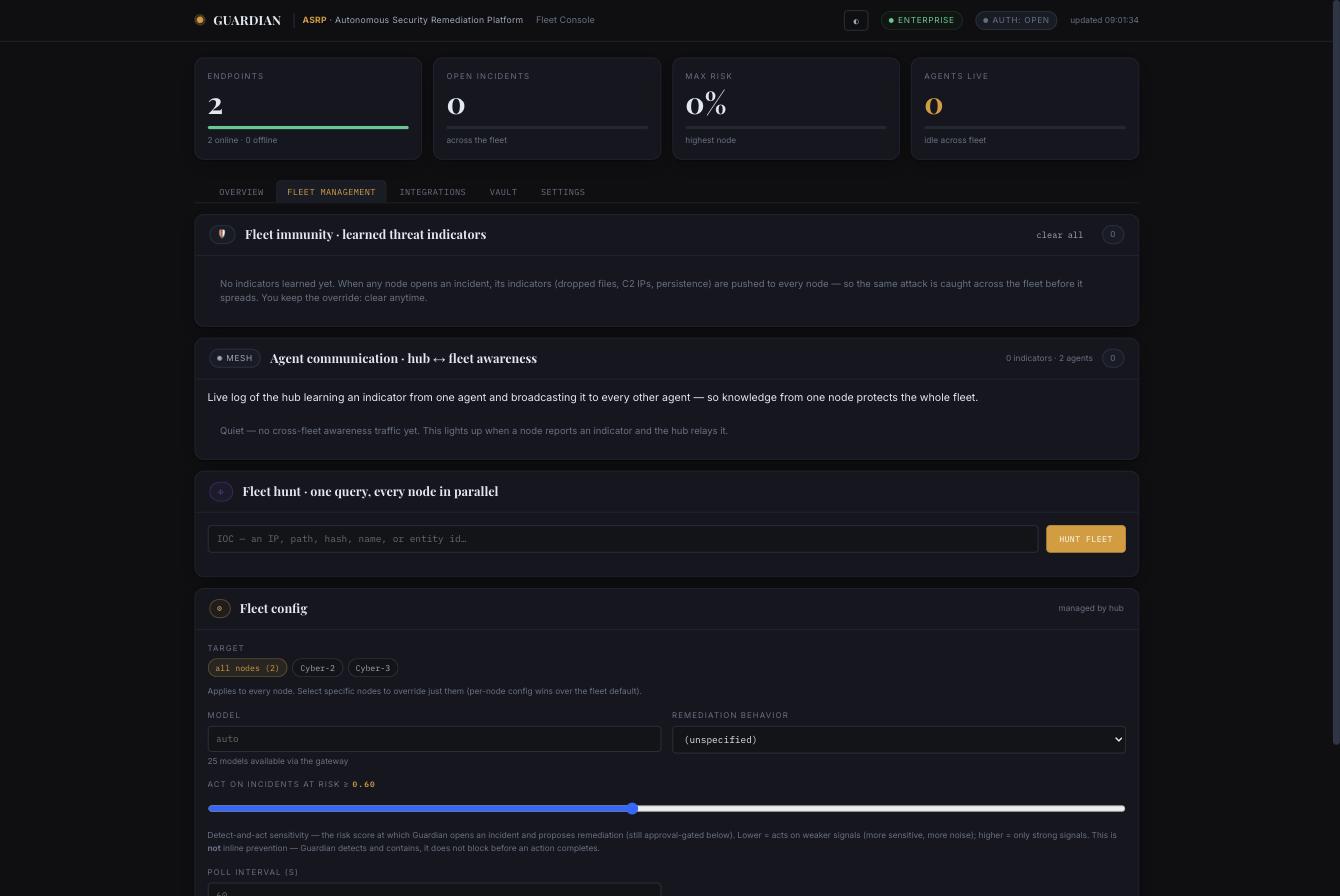
Antemure fleet management: risk thresholds, remediation policy, fleet immunity and hunt
Fleet policy — risk thresholds, autonomy scope & approval queue, per node
One pane of glass

Your whole fleet, at machine speed.

A live risk heat map that scales to tens of thousands of endpoints, an AI analyst that takes action across the fleet, and every EDR/identity/SIEM source correlated into one detect → remediate loop.
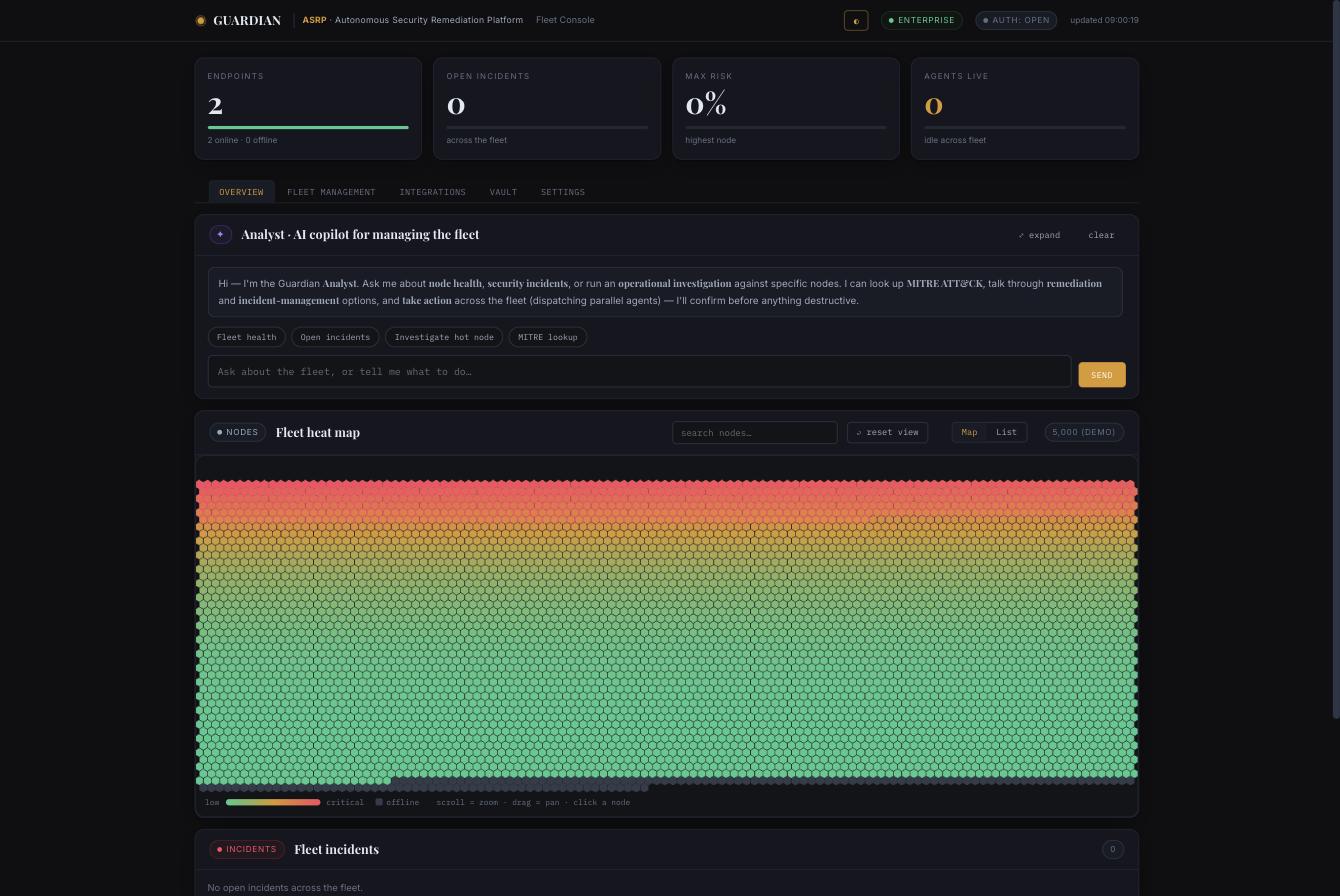
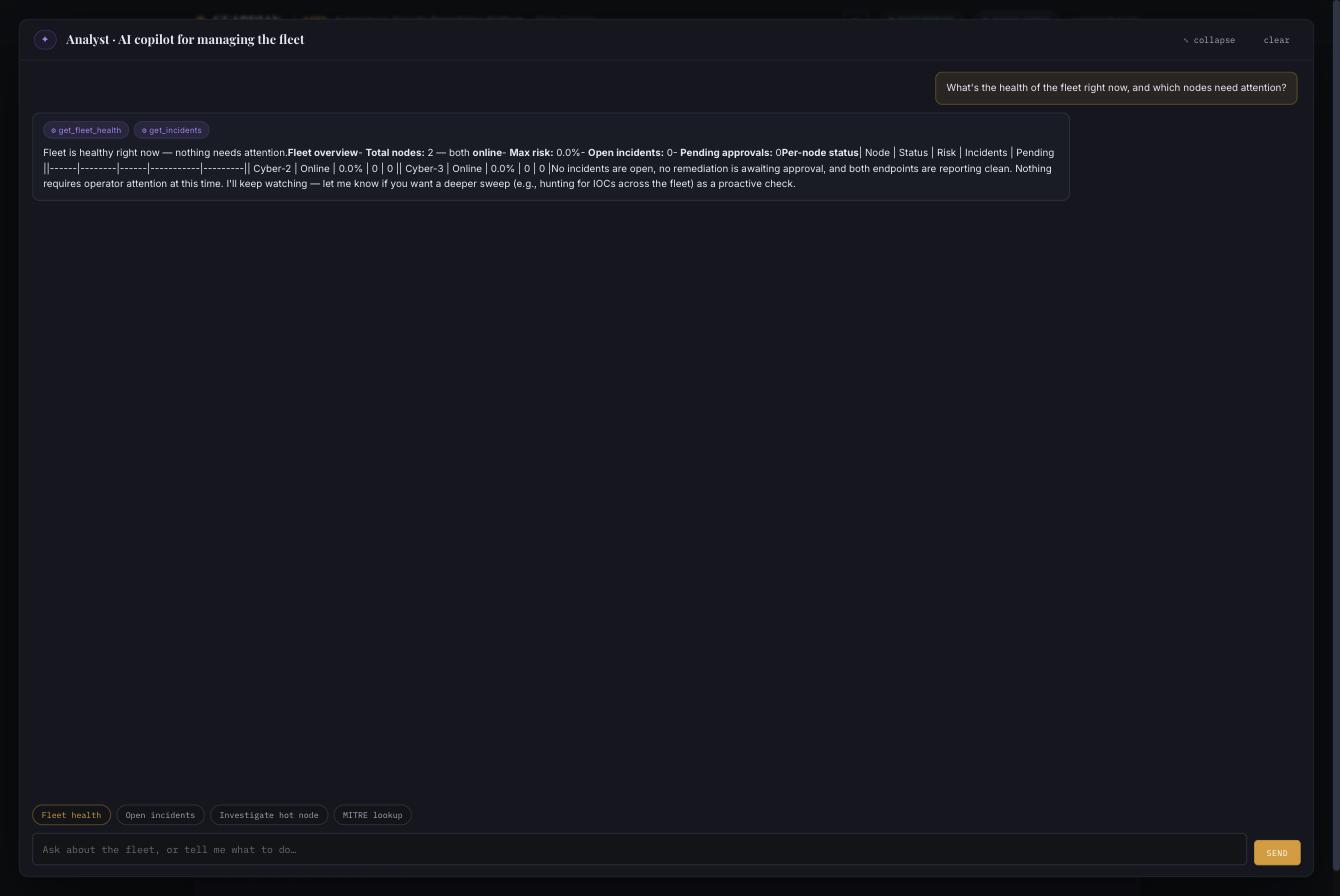
Antemure fleet console with a live hexagonal risk heat map and AI analyst copilot
Antemure fleet console — live risk heat map + AI analyst copilot
AI analyst answering with tool calls
AI analyst · acts across the fleet
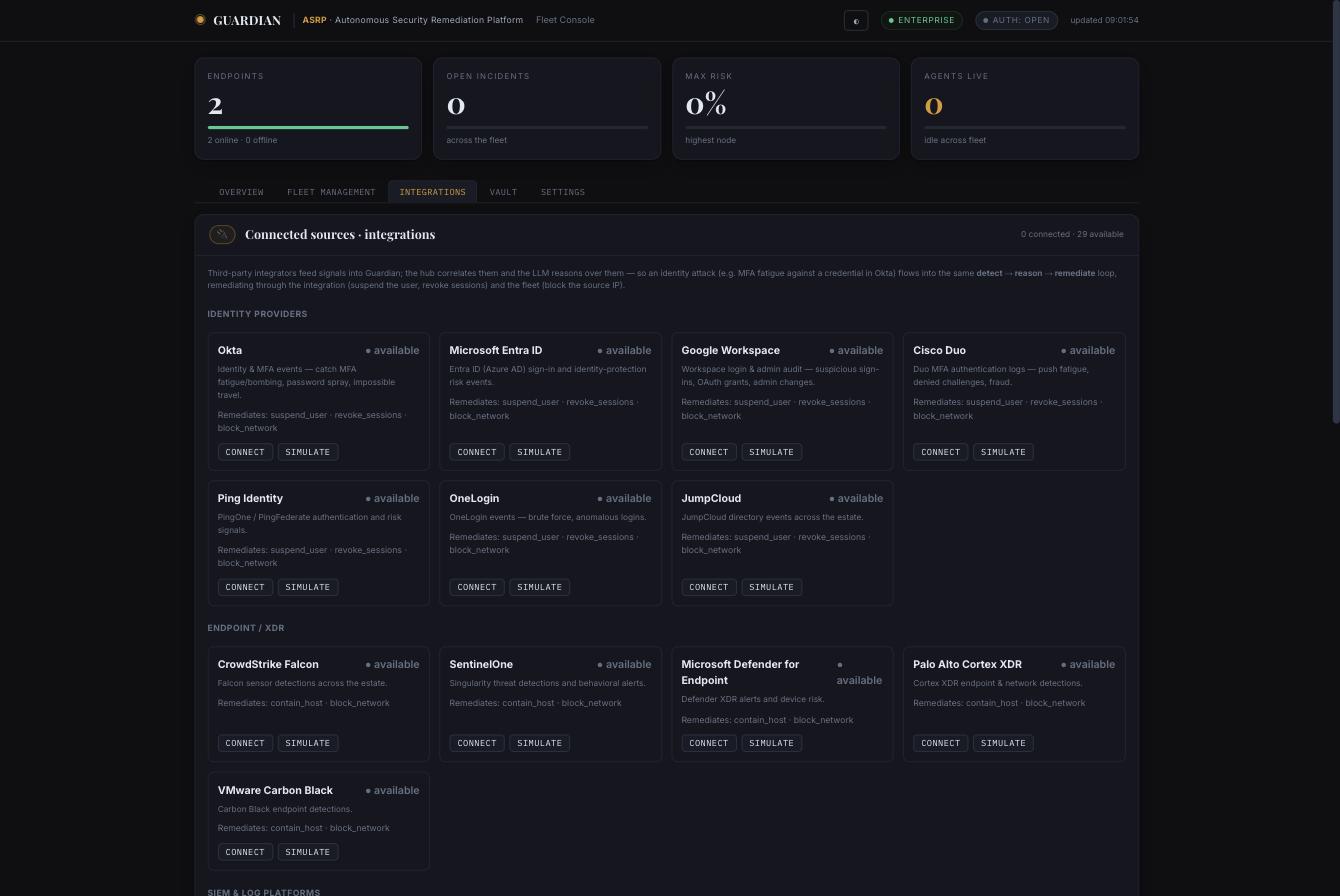
SIEM and cloud integrations
29 integrations · EDR / identity / SIEM / cloud
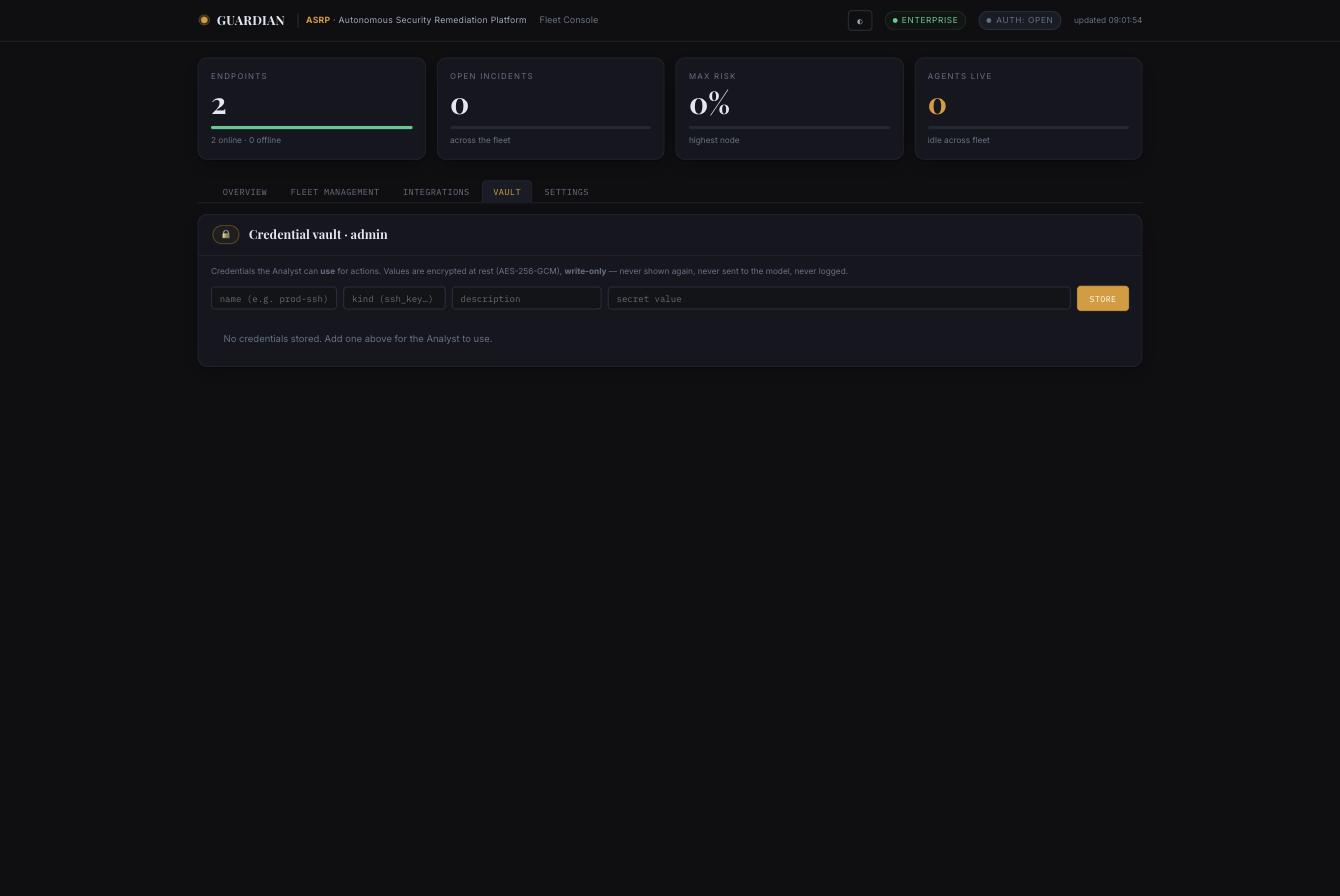
Credential vault encrypted at rest
Credential vault · AES-256, never sent to the model
Quantify the pain

The industry's own numbers
make the status quo indefensible.

~10 days
median attacker dwell time
Mandiant M-Trends 2024
$4.88M
average cost of a breach
IBM Cost of a Data Breach 2024
~258 days
to identify & contain a breach
IBM 2024
~$2.2M
saved with security AI + automation, ~98 days faster
IBM 2024

Your stack got dwell time down to about ten days. Antemure measures MTTR in seconds. Days versus seconds is the gap where a contained incident turns into a breach — and Antemure is the automation that closes it, running the one step no one else automates, the remediation itself, at machine speed.

Straight answers

The questions every buyer asks.

Antemure complements the stack you already own — we don't rip and replace. Here are the honest answers to the objections we hear most.

We already run best-in-class EDR.
Keep it — that's exactly what you want. EDR detects and can isolate; after the alert, a human still investigates and remediates. Antemure consumes that detection and closes it autonomously — root cause, kill, de-persist, verify — in seconds. EDR is the sensor; Antemure is the responder.
Our MDR already covers this 24/7.
MDR is humans-as-a-service, and their SLA is to notify — MTTA in minutes, MTTR in hours, and they usually hand you the runbook. Antemure resolves in the window MDR is still acknowledging, with zero per-incident human cost. Keep MDR for judgment calls; auto-remediate the commodity 80%.
XDR already correlates everything.
Correlation is valuable — but a correlated incident is still an alert someone has to act on. Antemure is the action layer XDR structurally lacks: pipe its incidents to us and we remediate across the endpoint and the source — suspend the user, revoke sessions, block the IP fleet-wide.
We'll just automate it with SOAR.
SOAR playbooks are pre-scripted and brittle — they break on the novel attacks that actually hurt, and every one is engineer time to maintain forever. Antemure reasons about the specific threat and composes the fix live, no runbook required — and agentic SOAR is coming, so you get both.
Isn't autonomous remediation too risky?
It's off by default, approval-gated, and bounded by hard guardrails — it can never touch operator access, kill its own agent, or run a forbidden command, and it verifies before it closes. The real risk is dwell time: the average breach hides for ~10 days. Speed is safety.
How do we know it actually worked?
A verified-remediation rate and a full per-incident audit trail — every command, its reasoning and its result — computed live on your own fleet during the POC. We sell proof, not slideware.
We can't send our data to a cloud.
Antemure runs on-prem or air-gapped with a bring-your-own or local model — no mandatory egress, and secrets and PII are redacted before anything leaves the box. Your keys, your infrastructure, your data residency.
Why not just build it with an LLM ourselves?
The LLM call is 5% of it. The 95% you'd be buying is what makes autonomy safe to run as root, unattended, across a fleet — operator lockout protection, forbidden-command guards, verified rollback, on-prem/BYO models, and a knowledge graph that makes every deployment smarter over time.
Pricing

Priced to your fleet.
Scoped in a conversation.

Antemure is an enterprise deployment — licensed per endpoint across your fleet, with autonomous remediation as an opt-in and on-premise / air-gapped options available. Tell us about your estate and we'll put together a demo and a quote that fit.

Antemure · Enterprise

Talk to our team for a demo

A live walkthrough on your own data — the fleet console, the multi-agent investigation loop, and approval-gated remediation — plus the full compliance pack for your vendor review. Every claim maps to a live scorecard number in the POC.

The rest of the platform

Self-serve pricing for our other products

Aura Workshop, Aura Gateway and the rest of the Aura platform have simple, published pricing — start free and upgrade when you need more.

Autonomous Security Remediation Platform

Stop alerting.
Start remediating.

EDR detects it. MDR tells you. XDR correlates it. Antemure fixes it — autonomously, at machine speed, with your team holding the final say.